Every game has its variety of gameplay and mechanical elements that make it fun, engaging, and thought-provoking. Components like dice, cards, unique pieces, and even the players themselves can contribute to the feeling of adventure and excitement of a given game. But what happens when these elements are too numerous or unwieldy? How do players react when the mechanics become so obstructive that they begin to overtake the game that they were supposed to be facilitating?
Take, for instance, The Fair at Grenden Village. My board game began with a simple an easy premise: players vie to earn the most money possible. Still, the method for reaching that end had to have rules and mechanics, so I created the shops that people would bring visitors to. I also created staff that would help change the course of play by increasing shop values or allowing the player more agency. All together, these mechanics were about as complex as I wanted the game to be – or so I thought.
As issues came to my attention, I did what every game designer tries to do: design my way out.
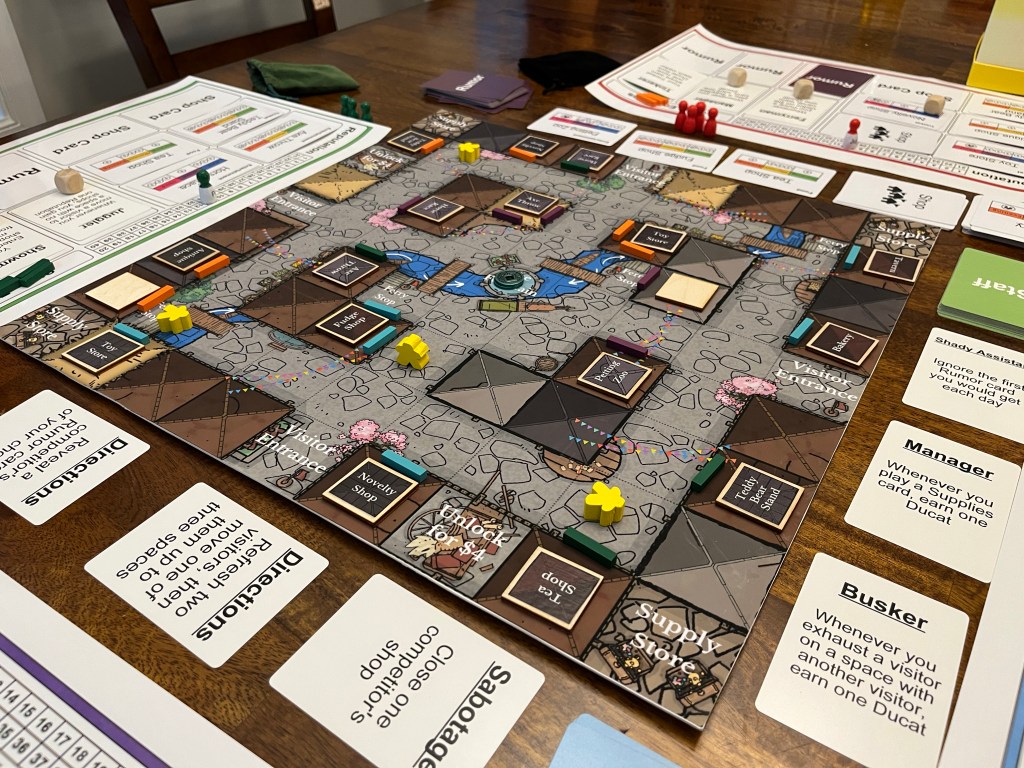
Initial playtesting was imperfect to say the least. Games went long, the deck didn’t have enough cards in it, and all the staff and visitors cluttered the board significantly. On top of all that, visitors seemed to be getting stuck in the corners of the map, without much reason or ability to move toward the center. As these issues came to my attention, I did what every game designer tries to do: design my way out. I removed staff from the board, increased the move distance of visitors, and created a new raffle mechanic that encouraged players to open shops and move visitors to the center of the board.
Layers upon layers
All of my new changes worked, but some also added significant new layers to the game. Now players were after not one resource, but two: Money, and raffle tickets(themselves only an avenue for earning more money). Still, the game was playing better and players mostly enjoyed the unpredictability that the raffle provided, so I considered this a win.
It wasn’t until I played a few more playtest games that I found that earning money was too narrow a mandate; too simple a goal. So again I began to tweak the system, picking my brain for ways that the play could be deeper and involve more choices. That lead me to an elegant, if tricky solution: adding a second win condition, this time in the form of reputation. Now players would earn reputation for each visit to one of their shops, creating an incentive to visit not just the highest-earning areas but also the most thickly settled.
Players now had to track yet another resource.
Introducing reputation as an alternate win condition created two new layers of complexity: First, players now needed to track yet another resource. Second, players had to judge whether that resource was more important than money. At the same time, I decided that since staff were off the board and reputation was going to be tracked on a player mat, I could introduce another mechanic to encourage players to hire more staff: tracking wages.
So for those keeping track at home, here is a (non-comprehensive) list of the things a player would likely be tracking during just one game of The Fair:
- Money
- Reputation
- Raffle tickets
- Exhausted/refreshed visitors
- Visits to certain shops
- Wages paid to staff
- Rumors
- Types of cards in supply stores
- Cards in hand
- Phase of the day
- Day of the fair
- Money in the fountain
- Staff abilities
When you see it laid out this way, it seems overwhelming. That’s an indication that the game is feeling the weight of all these mechanics. And while each of them has a purpose and had a valid reason for existing, the total impact of this bloat is a game that feels more akin to long division than a festival in a medieval town square.
Seeing the forest for the trees
So, where do we go from here? While the game might benefit from a slimming down, it’s hard to cut any one mechanic without feeling like something precious is being lost. The key for me has always been to reframe the problem in the form of a few questions:
- Is this a core mechanic of the game?
- Are other mechanics improved by this one?
- Is this mechanic fun?
When I look at these questions I can recontexualize the smaller aspects of the game that might be weighing down the overall experience, and I can find ways to eliminate them or integrate them into another aspect of the game.
There are no perfect games or seamless designs; if there were, we wouldn’t need to keep designing new ones. But just as each design has its moments of brilliance and fun, they also have their stretches of monotony or moments of confusion. For a game to be truly great, it must bring to the bottom line a resonant and engaging puzzle, and not get lost in the taxes of its own complexity.
 Gallogly Games